877-852-8463CareersLocationsPatient PortalRequest Appointment

Specialty Eye Institute

Premier providers of eye surgery and LASIK in Michigan and Northwest Ohio

  • About
    • Call Now
    • Testimonials
    • Join Our Team
    • News & Events
  • Eye Doctors
    • SEI Doctors
    • Affiliate Doctors Login
  • Services
    • Eye Exams
    • Cataract Eye Surgery
      • Laser Cataract Surgery
      • Cataract Surgery Lens Options
      • Cataract FAQ
    • LASIK Eye Surgery
      • Take Our LASIK Self-Test
      • LASIK Pricing
      • Affordable Options for LASIK
      • Financing
      • LASIK FAQs
    • EVO ICL Eye Surgery
    • Refractive Lens Exchange Surgery
    • Dry Eye Treatment
    • Retinal Detachment Treatments
    • Corneal Transplants
    • Blepharoplasty Treatments
  • Vision Conditions
    • Astigmatism
    • Diabetic Retinopathy
    • Diplopia
    • Glaucoma
    • Hyperopia
    • Keratoconus
    • Low Vision
    • Macular Degeneration
    • Macular Edema
    • Macular Holes
    • Myopia
    • Presbyopia
    • Vitreous Detachment
  • Resources
    • What to Expect at Your Eye Appointment
    • Patient Forms
    • Video Library
    • Financing
    • Retina Care
      • Eye Anatomy
      • Epiretinal Membrane (Macular Pucker) Treatment & Surgery
      • Free Printable Amsler Grid Test PDF
    • Travel Support
    • Newsletter Sign Up
    • No Surprises Act: Billing Disclosures
    • Notice of Availability
    • Notice of Nondiscrimination
  • Surgery Centers
    • Lansing
    • Jackson
  • Contact
    • Call Now
    • Schedule Appointment

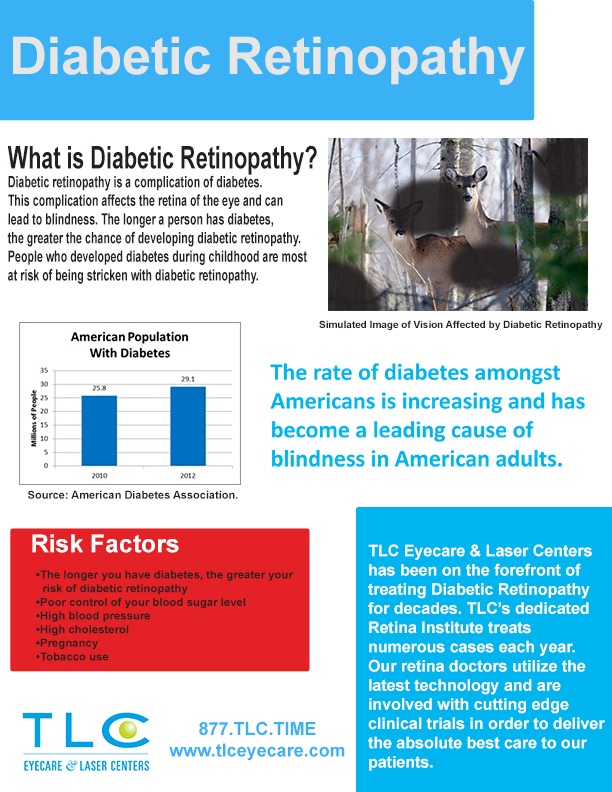
November is Diabetes Awareness Month

The rate of diabetes amongst Americans is increasing and has become a leading cause of blindness and other health issues in American adults.

Diabetic Retinopathy is a complication of diabetes affecting the retina of the eye and can lead to blindness. Here’s an infographic for more information on Diabetic Retinopathy.

Download Infographic
November is Diabetes Awareness Month

November 29, 2016 Filed Under: Blog

Dr. Ernest on the Bart Hawley Show

Dr. Paul Ernest appeared on the Bart Hawley Show last week to discuss the new lens for cataract surgery that is changing the game.

Dr. Paul Ernest on The Bart Hawley Show from JTV Studios on Vimeo.

April 26, 2016 Filed Under: Blog

The Three Major Advantages of the Latest Corneal Transplant Surgery

Who Is Corneal Transplant Surgery For?

Over 40,000 people undergo a cornea transplant in the United States each year. Corneal transplant surgery is recommended for people who have:

  • Vision problems are caused by thinning of the cornea, most often due to keratoconus. A cornea transplant may be considered when less invasive treatments are not an option.
  • Scarring of the cornea from severe infections or injuries
  • Vision loss is caused by cloudiness of the cornea, most often due to Fuchs’ dystrophy

During these procedures, damaged tissue on the eye’s clear surface – the cornea – is replaced.

Replacing The Cornea

As the front, clear layer of the eye, corneas are a unique part of the body and feature five layers (from front to back); Corneal epithelium, Bowman’s layer, Corneal stroma, Descemet’s membrane, and Corneal endothelium. Problems with any of these layers can cause blurred vision, glare, and distortion.

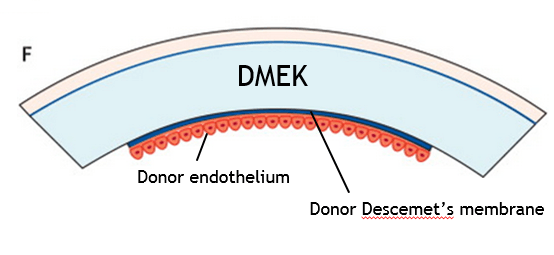
dmek corneal transplant surgeryUp until 2006, when the cornea became cloudy, transplant procedures required the removal of all five layers of the cornea and replaced it entirely. This required a lengthy and uncertain visual recovery period. In 2006, Dr. Kevin Lavery was the first in Michigan to perform Descemet Stripping Automated Endothelial Keratoplasty (DSAEK).



This was a vast improvement as the top two layers of the cornea were undisturbed. Now we have Descemet Membrane Endothelial Keratoplasty (DMEK). DMEK is not only changing the way cornea transplants are performed, but also improving the results. With this procedure, only the innermost layers are replaced. Removing fewer layers means a more pure replacement.

The DMEK procedure targets patients whose inner endothelial cell layer is diminished and the stroma is becoming waterlogged. The cornea’s transparency is dependent on its inner cells’ ability to pump fluids – and when it fails, it swells and results in cloudy eyes.

Before DMEK, Descemet’s Stripping Automated Endothelial Keratoplasty (DSAEK) was the most common transplant procedure.

Three Advantages of DMEK over DSAEK Corneal Transplant Surgery

Improved Vision

Greater portions of DMEK patients are attaining 20/20 vision or better following the procedure compared to DSAEK.

Improved Visual Recovery

While a patient’s vision is a bit fuzzy following the procedure, as the days progress it improves. For DMEK, the visual recovery path is much faster, taking only weeks instead of months. Patients are able to resume normal activities more quickly as well, as most are back to their regular activities within a week.

Reduced Risk of Rejection

When replacing the entire cornea, there is a risk of rejection. In procedures where all five layers are removed, rejection occurs in about 20% of the transplants. With DMEK, that risk is reduced to 1-2%.

The DMEK procedure takes about 30 to 40 minutes, a slightly longer procedure than DSAEK. However, the process is still being mastered, so it’ll likely soon become a shorter procedure. During the procedure, the patient is administered anesthesia and the diseased innermost layer of the cornea is carefully removed. Then, the healthy donor cornea is inserted and held in place by an air bubble, which goes away within the first week.

Specialty Eye Institute is proud to offer this procedure. It’s a procedure that requires a commitment from our entire team – from the staff to the eye doctors. Many eye surgeons in the state still aren’t performing this technique because of the steep learning curve and required training. Contact SEI today to learn more about corneal transplant surgery!

April 6, 2016 Filed Under: Blog

Will Diabetes Negatively Impact My Eyes & Vision?

True or False: The Longer You've had Diabetes, the Higher the Chance of Developing Trouble in the Back of the Eyes

Diabetic retinopathy is the leading cause of vision loss and eye problems in the working-age population in our country.

The answer is true: The key thing to remember about Diabetic Eye Disease is the longer you've had Diabetes, the higher the chance of developing problems in the back of the eyes. Diabetes causes trouble in the retina and eyesight issues in a number of ways. Primarily, when you've had Diabetes for many years, this results in damage to the small blood vessels in the back of your eyes.

So when these blood vessels are damaged, the eye is not getting enough Oxygen and that leads to a series of events that can cause loss of eyesight. For example, you can get fluid build-up in the macula, which is the very center part of the retina. That can cause trouble with reading, driving, and normal activities.

In addition, abnormal blood vessels can grow in the back of the eyes. These blood vessels can proliferate, they're very fragile, they can cause bleeding and scarring, and even a detached retina, which can cause patients to go blind. The key to Diabetic Retinopathy is to watch your blood sugar.

Controlling your blood sugar will reduce the risk of severe vision loss by more than 50%. Now once you have Diabetic Retinopathy, it's very important to see a retina specialist because we have excellent treatments now that can stabilize the vision and in many patients, improve vision. If you are having vision issues at night or during the day, give our team a call by phone at (877) 852-8463 to book an appointment. Our ophthalmologists and optometrists offer various types of vision care solutions such as diabetic retinopathy treatments, LASIK eye surgery, keratoconus treatments, and cataract surgery. Do you have diabetes? Our doctors will work with you to develop a vision care strategy to improve your sight and life.

Author

Surendar Purohit, MD
Surendar Purohit, M.D.
Vitreoretinal Specialist

October 13, 2021 Filed Under: Blog

Specialty Eye Institute Welcomes Alexander Cherry, M.D., Glaucoma & Cataract Specialist

Glaucoma and Cataract Specialist Alexander Cherry At Specialty Eye InstituteSpecialty Eye Institute is pleased to welcome Alexander Cherry, M.D. to the practice. Dr. Cherry is a Glaucoma and Cataract Specialist who is accepting new patients at the Adrian, Bryan and Toledo locations.

“SEI is very fortunate to add Dr. Cherry to our practice.  As a fellowship trained glaucoma ophthalmologist, he is a highly skilled surgeon who will provide our patients, the greater Toledo area, and our referring doctors state-of-the-art care as a glaucoma and cataract surgeon,” says Dr. David Bejot, Clinical Optometric Director at Specialty Eye Institute.

Dr. Cherry grew up in the Toledo area and is a diehard Buckeyes fan. He graduated from Ohio State University College of Medicine and completed his residency and Glaucoma Fellowship at the University of Kentucky.

“I am very excited to be bringing expanded access to glaucoma services to the practice. It feels like a long time in the making to return to the Toledo area to practice and I cannot wait to get started,” states Dr. Cherry.

July 6, 2020 Filed Under: Blog Tagged With: Alexander Cherry, Cataract Specialist, Glaucoma Specialist, Toledo

  • «
  • 1
  • …
  • 14
  • 15
  • 16
  • 17
  • 18
  • …
  • 21
  • »
  • Eye Doctors
  • Specialty Eye Institute Locations
  • Careers
  • News & Events
  • Schedule Appointment
  • Patient Resources
  • Contact Us

For Patients

  • Schedule Appointment
  • Patient Resources
  • Patient Forms
  • Billing and Insurance Information
  • Financing
  • ACA Non-Discrimination Notice
  • Legal Resources

For Doctors

  • Continuing Education Events
  • Grand Rounds
  • Referring a Patient
  • Clinical Forms

Make an Appointment

  • MM slash DD slash YYYY

Schedule Your Free Consultation Today

Schedule your LASIK Consultation
reCAPTCHA is required.

By submitting this form, you accept the Mollom privacy policy.


To find an optometrist near you, type your city and state or zip code.

FOR PATIENTS

  • Affiliate Doctors Home Page
  • Announcements
  • Order Supplies
  • Clinical Forms
  • Continuing Education Events
  • Grand Rounds
  • Logout

FOR DOCTORS

  • Affiliate Doctors Home Page
  • Announcements
  • Order Supplies
  • Clinical Forms
  • Continuing Education Events
  • Grand Rounds
  • Logout

CONTACT US

Phone Icon to Call Specialty Eye Institute of Michigan and Ohio 877-852-8463

SOCIAL MEDIA

SIGN UP NEWSLETTER

We Are a Proud Partner Of

  • Home
  • About Us
  • Patient Resources
  • News
  • Locations
  • Careers
  • Privacy Policy
Specialty Eye Institute © 2026
Digital Marketing by Youtech. 8778528463

Copyright © 2026 · specialtyeyeinstitute on Genesis Framework · WordPress · Log in

Pencil Icon - Cataract Information CATARACT
SELF-TEST
Pencil Icon - Lasik Self-Test LASIK
SELF-TEST
Pencil Icon - Schedule Appointment at SEI SCHEDULE
APPOINTMENT
877-852-8463Newsletter Sign UpLocationsPatient PortalSchedule Appointment
  • About
    • Call Now
    • Testimonials
    • Join Our Team
    • News & Events
    • Back
  • Eye Doctors
    • SEI Doctors
    • Affiliate Doctors Login
    • Back
  • Services
    • Eye Exams
    • Cataract Eye Surgery
      • Laser Cataract Surgery
      • Cataract Surgery Lens Options
      • Cataract FAQ
      • Back
    • LASIK Eye Surgery
      • Take Our LASIK Self-Test
      • LASIK Pricing
      • Affordable Options for LASIK
      • Financing
      • LASIK FAQs
      • Back
    • EVO ICL Eye Surgery
    • Refractive Lens Exchange Surgery
    • Dry Eye Treatment
    • Retinal Detachment Treatments
    • Corneal Transplants
    • Blepharoplasty Treatments
    • Back
  • Vision Conditions
    • Astigmatism
    • Diabetic Retinopathy
    • Diplopia
    • Glaucoma
    • Hyperopia
    • Keratoconus
    • Low Vision
    • Macular Degeneration
    • Macular Edema
    • Macular Holes
    • Myopia
    • Presbyopia
    • Vitreous Detachment
    • Back
  • Resources
    • What to Expect at Your Eye Appointment
    • Patient Forms
    • Video Library
    • Financing
    • Retina Care
      • Eye Anatomy
      • Epiretinal Membrane (Macular Pucker) Treatment & Surgery
      • Free Printable Amsler Grid Test PDF
      • Back
    • Travel Support
    • Newsletter Sign Up
    • No Surprises Act: Billing Disclosures
    • Notice of Availability
    • Notice of Nondiscrimination
    • Back
  • Surgery Centers
    • Lansing
    • Jackson
    • Back
  • Contact
    • Call Now
    • Schedule Appointment
    • Back