 877-852-8463
 Careers
 Locations
 Patient Portal
 Request Appointment
Eyes can be particularly vulnerable to damage, which is why there are so many types of surgeries that are designed to remove, repair, or manipulate your eye and its surrounding tissues.
Let’s discuss the different eye surgery types, why you would have them, the risks that eye surgeries come with, and what the recovery process is like.
Eye Surgery Types
Refractive Eye Surgery

Refractive eye surgery corrects refractive errors like myopia (nearsightedness), hyperopia (farsightedness), and astigmatism.
LASIK: Laser-Assisted In Situ Keratomileusis
LASIK is the most well-known refractive surgery. This procedure reshapes the tissue under the cornea’s surface by creating a flap and targeting it with a laser.
PRK: Photorefractive Keratectomy
PRK also reshapes the cornea but does not require a flap. The top layer of the cornea is removed so that a laser can reshape the cornea. Then, the top layer grows back over the next several days.
LASEK: Laser Subepithelial Keratomileusis
LASEK is similar to PRK, but a flap is created and placed back after the laser treatment. Some experts think that this promotes a more comfortable experience and faster recovery.
Refractive Lens Exchange
Refractive lens exchange is a similar procedure to cataract surgery. However, in this procedure, the eye’s clear natural lens is replaced with an artificial lens to correct the refractive error.
Cataract Surgery
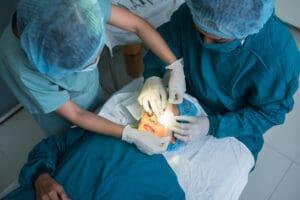
Cataract surgery involves the removal of the eye’s natural lens that has become cloudy with age and replacing it with a clear artificial lens.
In the surgery, the surgeon removes the natural lens and replaces it with a clear artificial lens referred to as an intraocular lens (IOL). The IOL is placed inside the lens capsule that was designed to hold the natural lens.
This procedure is low-risk and takes about 15 minutes. You will be able to go home the same day.
Three Types of Cataracts
- Nuclear Cataract: this is the most common type of cataract in the senior population. It is a clouding and hardening of the lens center, which results in a blur, glare, and other changes in vision.
- Cortical Cataract: this is an opacity in the outer layer of the natural lens. It’s more common in people with diabetes and hypertension.
- Posterior Subcapsular Cataract: this is a fast-growing opacity in the rear of the natural lens. This cataract is most common in people who take steroids or have diabetes.
Glaucoma Surgery
Glaucoma surgery is performed to lower the pressure inside the eye in people with glaucoma. When the pressure in the eye is too high, the risk of vision loss increases due to potential damage to the optic nerve.
Argon Laser Trabeculoplasty (ALT)
This is an in-office procedure that’s generally performed on people with open-angle glaucoma who have eye pressure because the fluid in front of the eye is not draining properly. It drains fluids out of your eye in order to reduce intra-ocular pressure.
Selective Laser Trabeculoplasty (SLT)
Much like ALT, this procedure is generally performed on people with open-angle glaucoma. It uses a cold laser to drain the fluids in your eye and reduce intraocular pressure. The cold laser reduces scar tissue, making it a surgery that can be repeated if needed.
Laser Peripheral Iridotomy (LPI)
This is an in-office laser procedure that’s used to treat or prevent narrow-angle glaucoma, which is much less common than open-angle glaucoma. Because the angle is narrow, it can close and increase in a sudden increase in eye pressure.
The surgery will ensure that the meshwork drains properly, but the drainage area will be narrowed or closed.
Trabeculectomy
This filtration surgery requires an incision and is used to treat open-angle glaucoma. The procedure will need to be performed in a hospital and is generally an option that is taken if medication and laser surgery are not effective.
Retinal Surgery
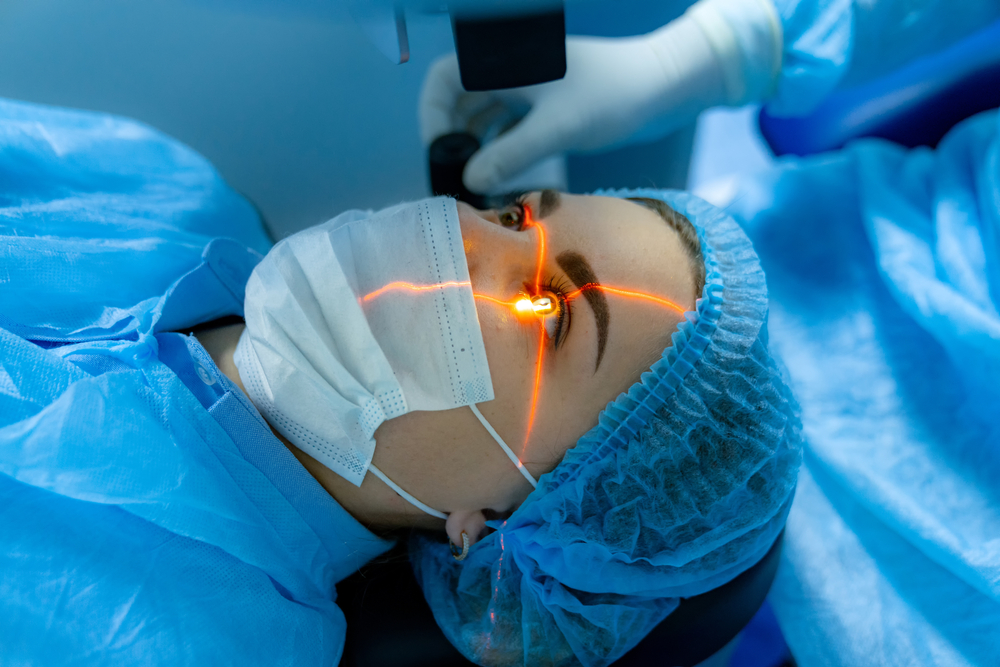
The retina is the light-sensitive tissue in the back of the eye that is susceptible to damage and diseases. There are numerous types of surgeries to treat the retina and its surrounding structures.
Retinal Laser Photocoagulation
Laser photocoagulation uses a laser to slow down or prevent serious complications that could lead to vision loss.
It manages conditions like:
- Diabetic retinopathy
- Macular edema
- Retinal vein occlusion
- Retinal detachment
In this procedure, a laser generates heat and creates a burn, stimulating the development of scar tissue. This scar tissue can help seal off abnormal, leaky blood vessels and reduce swelling. Additionally, tears or detachments can be “welded” down with this procedure to prevent further vision loss.
Photodynamic Therapy (PDT)
When the treatment area is near the center of vision, PDT is preferred over laser photocoagulation to minimize the chances of developing a blind spot. This procedure is commonly used in wet age-related macular degeneration patients.
It uses a laser and an injected drug that works in tandem. The drug is injected into the arm, travels to targeted blood vessels, and is activated by a low-power laser directed at leaky blood vessels. This procedure seals the blood vessels, which reduces the amount of fluid and blood they leak.
Cryotherapy
This procedure places a probe that freezes tissue to treat a retinal tear or detachment. The probe damages the tissue surrounding the tear, which results in a scar that “welds” it into place.
Scleral Buckle
A person with retinal detachment will be treated with either laser photocoagulation or cryotherapy, which will then be followed by the placement of a scleral buckle. This is a silicone band placed on the outside of the sclera to help prevent the retina from detaching again
This procedure is outpatient and will require either local or general anesthesia. The surgery typically lasts around two hours.
Pneumatic Retinopexy
During a pneumatic retinopexy, the eye is numbed, a small needle is inserted, and fluid is removed and replaced with a gas bubble. The gas offers gentle pressure against the retina to help it reattach.
This procedure would need to be followed up by a laser photocoagulation or cryotherapy.
Vitrectomy
A vitrectomy removes the vitreous, which is a gel-like fluid that fills the back two-thirds of the eye, providing support and maintaining its round shape.
This procedure could be performed for conditions like:
- Diabetic retinopathy
- Retinal detachment
- Macular pucker
- Macular hole
- Endophthalmitis
- Trauma
This outpatient procedure requiring local or general anesthesia involves a small incision made in the eyeball to remove the vitreous and replace it with saline or a bubble of gas and silicone oil. A patch will need to be placed over the eye, and medication will be given to help the eye heal.
Corneal Transplant
Corneal transplant surgery may be necessary when the cornea becomes severely damaged.
This procedure can help heal the damage from:
- Corneal infection
- Inflammation
- Severe dryness
- Dystrophies
- Degenerations
- Injuries
Penetrating Keratoplasty
This is a full-thickness cornea transplant. A diseased cornea is replaced with a healthy donor cornea.
Endothelial Keratoplasty
This is a partial corneal transplant that doesn’t need stitches. The back layers of the cornea are replaced.
Deep Anterior Lamellar Keratoplasty
This procedure replaces the middle tissue layers of the cornea with donor tissue.
Superficial Anterior Lamellar Keratoplasty
This procedure replaces the cornea’s outer layers with donor tissue.
Eye Muscle Surgery
Eye muscle surgery assists in aligning the eyes in a condition referred to as strabismus. This is when the eyes point in different directions, causing double vision.
The muscle that needs to be adjusted will be shortened or reattached further back into the eye. Depending on the age of the patient, the procedure could require anesthesia. An overnight stay in the hospital usually isn’t necessary.
Eyelid Surgery
Eyelid surgery, or blepharoplasty, corrects eyelids that have become droopy, causing vision impairment. It can be performed on both the upper or lower lids and involves removing excess skin or fat. Then, the muscle that opens the eyes is repaired.
Risks Associated with Eye Surgery
With every surgery, there is always some amount of risk. With laser eye surgeries, one risk is that the procedure will be unsuccessful or need to be repeated eventually.
Eye surgeries also run the risk of:
- Pain
- Infection
- Bleeding
- Vision changes
- Dry eyes
There is also a small risk of vision loss after surgery. You can discuss the specific risks of your procedure with your surgeon during your consultation.

Recovery Process After Eye Surgery
The recovery time of your eye surgery will depend on the type of procedure that you have.
Cataract Surgery: typically takes four to eight weeks to recover completely, though your routine should be returned to before then.
LASIK: you will be able to go back to work the next day, but it may take up to four weeks to get back to all of your usual activities.
Glaucoma Surgery: the recovery time for this procedure is usually two to six weeks.
Corneal Transplants: you should have full vision after three months, though it could take as long as 12 months.
Listening to the instructions of your surgeon for aftercare is essential to guaranteeing a smooth recovery process. It’s also crucial to attend follow-up appointments so a professional can ensure that you are recovering as you should.
Ensuring Vision Health and Safety with Specialty Eye Institute
Promoting your eye health requires reliable care you can count on. At Specialty Eye Institute, our dependable team of specialists is dedicated to creating an exceptional experience, whether you're dealing with secondary cataracts, seeking LASIK eye surgery, or simply in need of a regular eye check-up.
We are devoted to providing the utmost care for your eyes. Here at Specialty Eye Institute, our foundational principles include:
- Patient-Centered Advocate
- Compassion
- Excellence
- Integrity
If you’re in need of eye care, don’t hesitate to call us at (866) 435-8935 or schedule an appointment on our website.




 877-852-8463
